
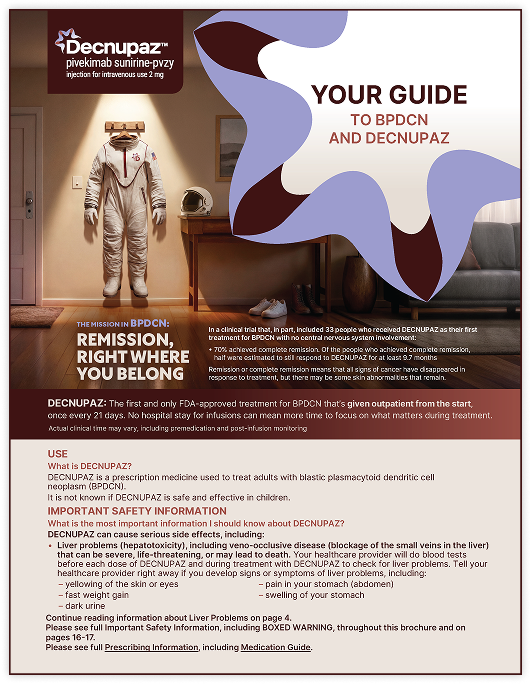
Remission, right where you belong
Remission or complete remission means that all signs of cancer have disappeared in response to treatment, but there may be some skin abnormalities that remain.
DECNUPAZ is a prescription medicine used to treat adults with blastic plasmacytoid dendritic cell neoplasm (BPDCN). It is not known if DECNUPAZ is safe and effective in children.
Remission or complete remission means that all signs of cancer have disappeared in response to treatment, but there may be some skin abnormalities that remain.
CLINICAL TRIAL RESULTS
*For full treatment experience information, such as premedication and monitoring information, see How DECNUPAZ Is Given.
To better understand the clinical trial results with DECNUPAZ, first consider these general terms relating to BPDCN. Remission or complete remission means that all signs of cancer have disappeared in response to treatment, but there may be some skin abnormalities that remain.
†With no central nervous system involvement.
‡Can include people with BPDCN with central nervous system involvement that was previously treated.

70%
(23 out of 33 people)
achieved complete remission
Of the people who achieved complete remission, half were estimated to still remain in remission for at least 9.7 months
49% (16 out of 33 people) achieved complete remission with no skin abnormalities remaining
21% (7 out of 33 people) achieved complete remission with some skin abnormalities remaining

~
4
out
of
10
(13 out of 33 people)
people went on to receive a stem cell transplant after DECNUPAZ treatment
16%
(8 out of 51 people)
achieved complete remission
Of the people who achieved complete remission, half were estimated to still remain in remission for at least 9.2 months
14% (7 out of 51 people) achieved complete remission with no skin abnormalities remaining
2% (1 out of 51 people) achieved complete remission with some skin abnormalities remaining
12%
(6 out of 51 people)
went on to receive a stem cell transplant after DECNUPAZ treatment
SIDE EFFECTS & MANAGEMENT
It is important to pay attention to how you feel and talk to your healthcare team right away about any discomfort or change in the way you are feeling, especially if having symptoms.
Your healthcare provider will do blood tests before each dose of DECNUPAZ and during treatment with DECNUPAZ to check for liver problems. Tell your healthcare provider right away if you develop signs or symptoms of liver problems, including:
Your healthcare provider will check you for liver problems during your treatment with DECNUPAZ and may provide treatment for your side effects. Your healthcare provider may also delay or stop treatment with DECNUPAZ if you have severe liver problems.
DECNUPAZ can cause serious, life-threatening infusion-related reactions. Your healthcare provider will give you medicines the day before and on the day of your infusion of DECNUPAZ to help reduce infusion-related reactions. Your healthcare provider will check you for symptoms of infusion-related reactions during your infusion and for at least four hours or longer if needed, after your first infusion, and for at least one hour after each of your next infusions. Tell your healthcare provider right away if you develop signs or symptoms of infusion-related reactions, including:
DECNUPAZ can cause your body to hold too much fluid during treatment. Your healthcare provider may prescribe water pills (diuretic) if you develop edema. Tell your healthcare provider if you develop new or worsening edema, including:
DECNUPAZ contains sodium metabisulfite, a sulfite that may cause severe, life-threatening allergic reactions in some people. Sulfite allergic reactions are more common in people with asthma than in people without asthma. Get medical help right away if you develop hives; itching; rash; swelling of the eyes, tongue, or lips; chest pain; or trouble breathing or swallowing.
Getting medical treatment right away is important. Your healthcare provider will check you for these problems during your treatment with DECNUPAZ and may provide treatment for your side effects. Your healthcare provider may also need to change your dose, delay, or completely stop treatment with DECNUPAZ if you have severe side effects.
These are not all of the possible side effects of DECNUPAZ. Call your healthcare provider for medical advice about side effects.
You may report side effects to the FDA at 1-800-FDA-1088.
Whether you are beginning treatment yourself or supporting someone who is, you can learn more about treatment and what it means for you with these brochures.
Patient Brochure
If you are starting DECNUPAZ, this brochure will guide you through what to expect and help you feel supported every step of the way.

Caregiver Brochure
If you are caring for a loved one starting DECNUPAZ, this brochure will help you understand your role, find support, and care for yourself as you care for your loved one.
BPDCN=blastic plasmacytoid dendritic cell neoplasm
What is the most important information I should know about DECNUPAZ?
DECNUPAZ can cause serious side effects, including:
Your healthcare provider will check you for liver problems during your treatment with DECNUPAZ and may provide treatment for your side effects. Your healthcare provider may also delay or stop treatment with DECNUPAZ if you have severe liver problems.
What should I tell my healthcare provider before receiving DECNUPAZ?
Tell your healthcare provider about all of your medical conditions, including if you:
Females who are able to become pregnant:
Males who have female partners who are able to become pregnant:
Tell your healthcare provider about all the medicines you take, including prescription and over-the-counter medicines, vitamins, and herbal supplements. Certain medicines may affect DECNUPAZ and increase your risk of side effects.
What are the possible side effects of DECNUPAZ?
DECNUPAZ can cause serious side effects, including:
The most common side effects include:
The most common severe abnormal laboratory test results with DECNUPAZ include:
Your healthcare provider may decrease your dose, delay your infusion, or permanently stop treatment with DECNUPAZ if you have side effects.
DECNUPAZ may cause fertility problems in males and females, which may affect your ability to have children. Talk to your healthcare provider if you have concerns about fertility.
These are not all the possible side effects of DECNUPAZ. Call your doctor for medical advice about side effects.
You are encouraged to report negative side effects of prescription drugs to the FDA. Visit www.fda.gov/medwatch or call 1-800-FDA-1088.
What is DECNUPAZ?
DECNUPAZ is a prescription medicine used to treat adults with blastic plasmacytoid dendritic cell neoplasm (BPDCN).
It is not known if DECNUPAZ is safe and effective in children.
Please see full Prescribing Information, including BOXED WARNING, or visit https://www.rxabbvie.com/pdf/decnupaz_pi.pdf.
If you are having difficulty paying for your medicine, AbbVie may be able to help. Visit AbbVie.com/PatientAccessSupport to learn more.
US-DECB-260005